

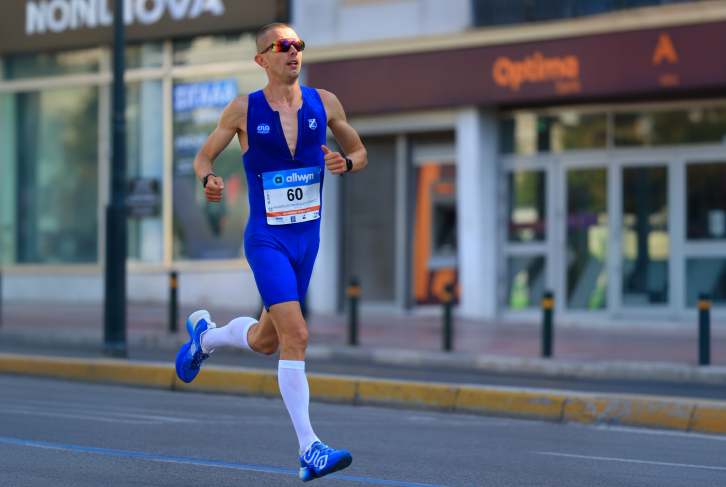
On Sunday, November 8, Amadeus Clements crossed the line inside the Panathenaic Stadium as the 7th Greek runner in the Athens Marathon, in 2:22.
It was not the win he came for. But look at his three Athens Marathons on the same course, from Marathon to the marble stadium:
| Year | Time |
|---|---|
| First Athens Marathon | 2:51 |
| Athens 2025 | 2:35 |
| Athens 2026 | 2:22 |
That is a 29-minute improvement in two years as a runner, on one of the hardest road marathons in the world. His message to the team the next morning: "next one it's a win."
He called it before the start
Before the race, Amadeus ran a series of key workouts designed to predict his Athens shape. The data was clear. On this course, right now, he was in the 2:22 to 2:25 range. Realistically, that meant a place between 5th and 7th among the Greek runners.
He finished in 2:22, 7th Greek.
"Just noticed I even predicted the position," he wrote the day after, with a microscope emoji.
That is the part of this race we want every runner to notice. Not because the prediction was impressive, but because of what it means: training data, read honestly, tells you what you are ready to run. Not what you hope to run. What you are ready for.
The race: in control, until kilometer 27
Amadeus raced the way he planned. He sat in the Greek lead pack, under control, through the flat start and up the long climb.
Then, at 27 km, the side stitch came back.
Last year, it hit him between 10 and 15 km, and took his race with it (we told that story in Unfinished business). This year, it came at 27 km. Same problem, much later in the race. He had to slow down, and the lead pack went on without him.
Moving it more than 10 km further down the road is real progress for one season. It is also a clear target for the next one.
What a 2:22 on this course means
The Athens course climbs for most of the first 31 km and gains over 300 meters of elevation. Times here are slow by big-city standards: the men's course record is 2:10:34. A 2:22 in Athens is worth significantly more on a flat course.
His next marathon will be a much flatter one: London.
What comes next
Amadeus does not take long to reset. His plan for the coming months:
- Back to Kenya in December, for three months of training in Iten.
- The Athens Half Marathon, with one goal: win the Greek championship.
- London Marathon, and a Greek national record attempt: 2:11.
- Another block in Kenya, to come back and win the Athens Marathon.
Season 2 is over. The next one starts in December.
What you can take from Athens 2026
- Use key workouts to predict your race. A few race-specific sessions in the final weeks tell you more about your real shape than any goal you set months earlier.
- Respect the prediction on race day. It is not a limit. It is the pace your body has earned.
- Judge progress across seasons, not single races. Amadeus missed his target and still ran 13 minutes faster than last year on the same course.
- Turn a recurring problem into a training goal. The stitch moved from 10 km to 27 km. Next, it has to go. That means rehearsing race-morning food and drink, controlling breathing in the early kilometers and building core strength.
- Keep going. "2:51, 2:35, 2:22. Next one it's a win."
Follow what comes next in the Road to Athens series on YouTube.